
Beginner Autoflowering Seeds
The fastest, most forgiving path from seed to harvest for a brand new grower.
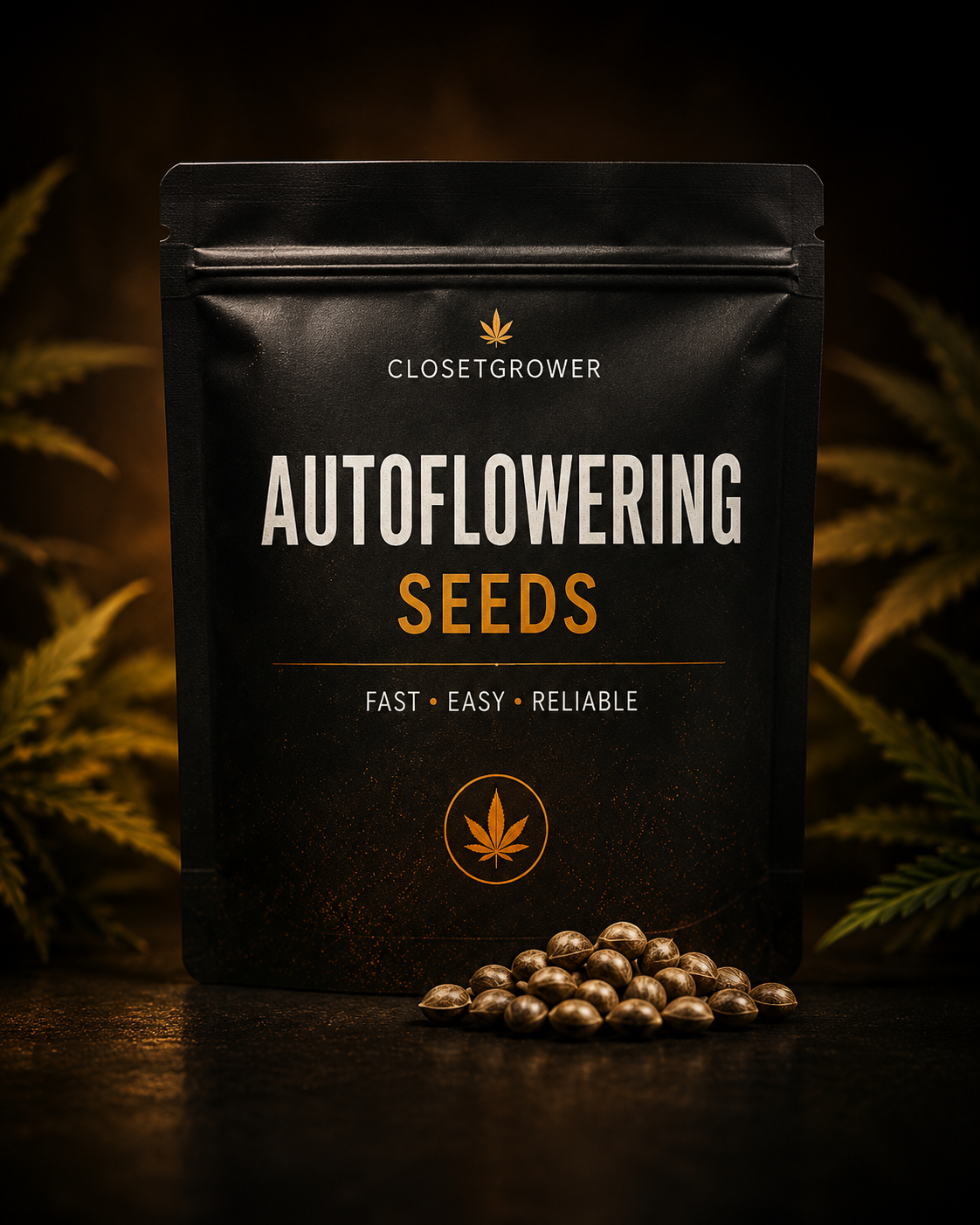
If you're reading this, you probably want one specific thing: a strain that won't punish you for being new. This guide covers exactly that — what to buy, how to plant it, how to feed it, when to back off, and how to not over-manage your first grow. We'll cover what an autoflowering seed actually is, why beginners almost always do better with autos than with photoperiods, the four mistakes that kill the majority of first grows, and the specific corner cases where an autoflower is the wrong tool for the job.
What is an autoflowering cannabis seed?
An autoflowering seed produces a plant that flips into flower based on age, not light schedule. Most autoflowers begin flowering around week 4 to 5 from sprout, regardless of how many hours of light they receive. That single trait — age-based flowering instead of light-based — is what makes autos so much more forgiving for new growers. You don't have to remember to switch your timer from 18/6 to 12/12. You don't have to plan a separate veg tent or block stray light from a closet door. The plant follows its own internal clock and finishes a full cycle in roughly 70 to 80 days from the day it pops.
The other thing autoflowers tend to do well is stay small. Most modern autoflower lines top out around 60 to 100 cm in a 3-gallon pot, which is exactly what you want when you're running a 2×2 tent or a closet without a tent. They stretch less in flower than a typical photoperiod, and a single early top is usually enough canopy management for a beginner. Compare that to a photoperiod that wants to be flipped at 25 to 30 cm and trained heavily through stretch, and the appeal becomes obvious. Browse autoflowering cannabis seeds for the broader catalog and the beginner-friendly cannabis seeds collection for our specific shortlist.
Why beginners almost always do better with autos
- Fixed timeline — no schedule decisions, no light-leak panic, no dialing the timer
- Compact size — fits a 2×2 tent comfortably with vertical room to spare
- Built-in resilience to common first-grow mistakes like overwatering and minor pH swings
- Harvest in roughly 70–80 days from sprout, so you learn faster across more cycles
- Most beginner-friendly lines are also feminized, removing the male-plant problem entirely
If you're trying to decide between an autoflower and a feminized photoperiod, read autoflowering vs photoperiod seeds — it's the single most useful comparison for a first-time buyer. The short version: photoperiods give you more total control, more training options, and (eventually) larger yields per plant. Autoflowers give you a fixed-length cycle and a forgiving plant. Almost every grower on their first or second cycle should pick the auto.
The five-line first-grow setup
- 2×2 tent with a 100W full-spectrum LED, dimmable
- 3-gallon fabric pot with decent organic soil — coco works too with more attention
- Direct-sow the seed into the final pot — autoflowers hate transplant shock
- Water when the pot lifts light, not on a schedule
- Light feeding from week 3, half the label dose, increase gradually
Tent size, pot size, light power, and feeding schedule are the four variables a beginner gets wrong most often, and each one tends to compound. A 4×4 tent for a single autoflower is overkill — the plant won't fill it, the airflow numbers won't balance, and you'll spend money on light coverage you don't need. A 1-gallon pot is too small — autos want room for the taproot to run through veg without checking the plant's growth. A 600W light over a 2×2 will cook the canopy. And full-strength nutrients on a week-2 seedling will burn it before it has the leaf mass to use them.
Light schedule for autoflowers
18 hours on, 6 hours off — from sprout to harvest. Don't change it. Some growers run 20/4 or 24/0 in veg for slightly faster growth, but 18/6 is the sweet spot for energy cost and plant health. The 6-hour dark period gives the plant a respiration cycle that produces measurably better root development. Stick with 18/6, plug your timer into a wall outlet, and walk away.
Pot size matters more than you think
The single biggest beginner mistake we see is using a pot that's too small. An autoflower only flowers once — there's no second chance to recover from a stunted root system in week 3. A 3-gallon fabric pot is the floor for most autoflower lines. Five gallons is fine if you have the floor space. Fabric pots specifically (not plastic) are worth the small extra cost because they air-prune roots and prevent the circular root-bound pattern that stunts growth in plastic pots. Direct-sow into the final pot — never transplant an autoflower seedling.
Watering mistakes that kill autoflowers
Overwatering is the number one killer of first-grow autoflowers. New growers tend to water on a schedule (every other day, every three days) rather than by feel. Autoflowers in fabric pots want a pronounced wet-dry cycle. The roots actively grow during the dry-back phase. If the soil never dries out, the roots stop searching for water, growth slows, and the plant becomes more susceptible to root rot and nutrient lockout. The fix is simple: lift the pot. If it feels heavy, wait. If it feels light, water. That's the whole rule.
When you do water, water enough that you get roughly 10 to 20 percent runoff out the bottom of the pot. Watering small amounts more frequently leaves the bottom of the root zone bone-dry while the top stays wet, which is the worst possible state. Big infrequent waterings, with full runoff, on a wet-dry cycle, every time.
Feeding mistakes that kill autoflowers
Overfeeding is the second most common killer. Autoflowers have a shorter total life cycle than photoperiods, which means they want a smaller total nutrient load. Start feeding around week 3 at half the label dose. Increase gradually as the canopy fills out, peak around mid-flower at full label dose, then back off in the last 1 to 2 weeks before harvest. The classic signs of nutrient burn — yellow-tipped leaves curling downward — are almost always overfeeding, almost never deficiency. When in doubt, dilute.
Mistakes that kill first grows
Overwatering. Overfeeding. Overtopping. Overpanicking. In that order. The single best thing a new grower can do is set up a 2×2, plant a beginner autoflower, and resist the urge to intervene every day. Cannabis is a weed. It evolved to survive bad weather, droughts, mineral-poor soil, and being chewed on. Most of what new growers do as "care" is actually intervention the plant didn't need. Lift the pot, look at the leaves, top once at the 4th node if you must, and otherwise leave it alone.
When autoflowers are not the right call
Autoflowers are not always the answer. If you have unlimited vertical space, a 4×4 or larger tent, and want maximum yield per plant, photoperiods will out-produce autos when grown well. If you want to clone, breed, or pheno-hunt, you need a photoperiod — autoflowers are typically grown from fresh seed every cycle. And if your timeline is flexible and you want the largest plant possible, photoperiods give you a separate veg phase to grow as much canopy as you want before flipping. For most home growers in tight spaces, none of those constraints apply, which is why we recommend autoflowers as a first cycle.
When to harvest your autoflower
Ignore week counters. Plants don't read calendars. Two cuts of the same strain in the same room can finish a week apart depending on temperature, humidity, and how stressed they got during stretch. Buy a 30× to 60× jeweler's loupe, look at the trichomes on the buds (not the sugar leaves), and harvest when most trichomes are milky white with about 10 to 20 percent turning amber. Cloudy trichomes mean peak THC. Amber trichomes mean THC degrading into CBN — couchlock. The exact ratio is personal preference, but most growers target the 80/20 milky-to-amber range.
What to buy
Pick a feminized autoflower marked Beginner Friendly. The pack guarantees a female plant, the line has been selected for forgiveness, and most of these cultivars also carry a Low Odor or Very Low Odor rating, which makes a closet or apartment grow much more realistic. Browse beginner-friendly cannabis seeds for our shortlist or cannabis seeds for closet growers if your space is specifically a closet or 2×2 tent. Night Sprint autoflowering seeds and Fogline autoflowering seeds are two beginner-friendly low-odor picks well-suited to a first cycle.
Quick questions.
- What's the easiest first strain to grow?
- A feminized autoflower marked beginner-friendly. The pack guarantees a female plant, the timeline is fixed at roughly 70–80 days from sprout, and the plant is forgiving of the small mistakes everyone makes the first time. Browse beginner-friendly cannabis seeds for our shortlist — Night Sprint autoflowering seeds and Fogline autoflowering seeds are two beginner-friendly low-odor picks well-suited to a first cycle.
- Do I really not need to switch the light schedule?
- Correct. Autoflowers run 18 hours on, 6 hours off from sprout to harvest. The plant flips into flower on its own around week 4 to 5 based on age, not light cycle. No timer changes, no schedule mistakes.
- How big a tent do I need for a first grow?
- A 2×2 tent fits one autoflower comfortably. If you're running directly inside a closet without a tent, aim for at least a 2ft × 2ft footprint with 5ft of vertical clearance. See best cannabis seeds for 2×2 tents for cultivar-specific picks.
- How often should I water?
- Lift the pot. If it's heavy, wait. If it's light, water. Don't schedule it. Most beginner failures come from overwatering — autoflowers in fabric pots want a wet-dry cycle, not constantly moist soil.
- When do I start feeding nutrients?
- Start around week 3 at half the label dose. Many beginners overfeed before the plant has the leaf mass to use it, which causes nutrient burn. Increase gradually as the canopy fills out, and back off in the last 1–2 weeks of flower.
- How do I know when to harvest?
- Buy a 30× to 60× jeweler's loupe. Look at the trichomes on the buds. When most are milky and 10–20% have turned amber, you're in the harvest window. Ignore week counters — plants don't read calendars.
Related collections.
- Beginner PickBeginner Autoflowering Seeds
Simple, resilient picks for newer growers and small-space setups.
Start Here - Fast CycleAutoflowering Seeds
Fast, simple genetics for growers who want a smoother path from seed to harvest.
Explore Autoflowers - New Grower FriendlyStarter Bundles
Curated packs for growers who want a simple first order without overthinking everything.
Shop Starter Bundles